
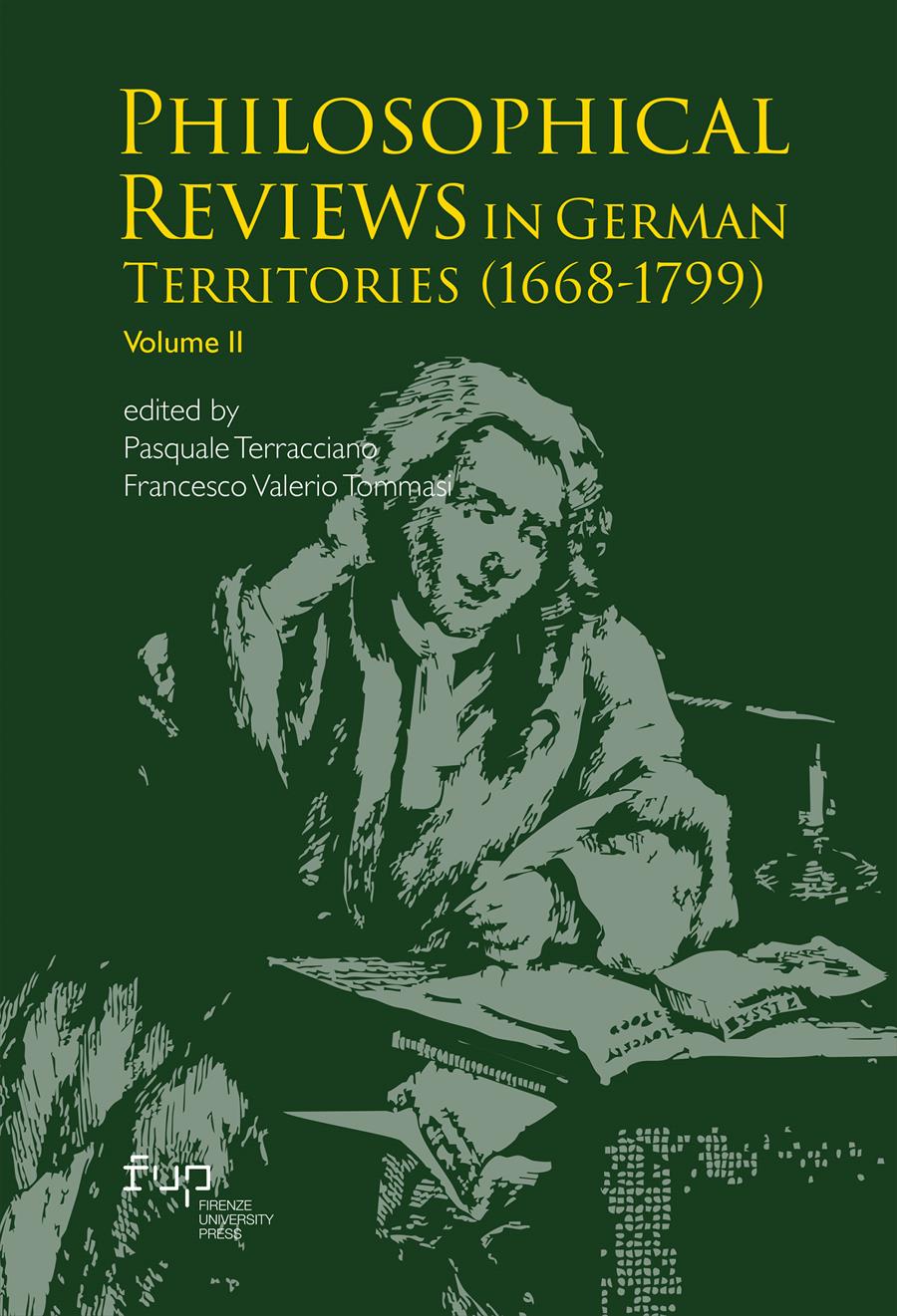
- Philosophical Reviews in German Territories (1668-1799)
- Edited by Pasquale Terraciano, Francesco Valerio Tommasi
Christian Thomasius and Reviewing as Philosophy
- Marco Sgarbi

- © 2026 Author(s) |
- CC BY 4.0
- DOI: 10.36253/979-12-215-0999-1.04
Christian Thomasius (1655–1728) was a foundational figure of early Enlightenment philosophy, renowned for his contributions to law, theology, and the development of philosophical journalism. His approach, Eclecticism, emphasized intellectual flexibility, rejecting dogmatism and skepticism in favor of critically synthesizing diverse traditions. Thomasius innovatively used reviews as philosophical tools, blending excerpts, critique, and dialogue to assess and integrate ideas. Through periodicals like Monats-Gespräche and Historia Sapientiae et Stultitiae, he advanced a unique methodology that democratized intellectual discourse, encouraging readers to engage critically with multiple perspectives. His later journalistic work, such as Summarischer Nachrichten von auserlesenen Büchern, balanced historical and contemporary scholarship, underscoring the enduring value of reviews in philosophical inquiry. By situating reviews at the heart of his eclectic philosophy, Thomasius demonstrated their power to challenge rigid systems and foster the pursuit of truth. His contributions remain a cornerstone for understanding the interplay between philosophy, journalism, and Enlightenment ideals.
- Keywords:
- Christian Thomasius,
- Eclecticism,
- philosophical journalism,
- Enlightenment,
- critical reviews,
Ca' Foscari University of Venice, Italy - ORCID: 0000-0002-6346-8167
- Albrecht, Michael. 1989. “Thomasius – kein Eklektiker?” In Christian Thomasius (1655–1728). Interpretation zu Werk und Wirkung. Hamburg: Meiner Verlag.
- Albrecht, Michael. 1994. Eklektik. Eine Begriffsgeschichte mit Hinweisen auf die Philosophie - und Wissenschaftsgeschichte. Stuttgart-Bad Cannstatt: Frommann-Holzboog.
- Beetz, Manfred, hrsg. von. 2003. Thomasius im literarischen Feld. New York-Berlin: De Gruyter.
- Carboncini, Sonia. 1989. “Die thomasianische-pietistische Tradition und ihre Fortsetzung durch Christian August Crusius.” In Christian Thomasius (1655–1728). Interpretation zu Werk und Wirkung, 287–304. Hamburg: Meiner Verlag.
- Décultot, Elisabeth, Fabian Krämer, and Helmut Zedelmaier. 2020. “Introduction: Towards a History of Excerpting.” Berichte Zur Wissenschaftsgeschichte 43: 169–79.
- Eskildsen, Kaspar Risbjerg. 2008. “Christian Thomasius, Invisible Philosophers, and Education for Enlightenment.” Intellectual History Review 18: 319–36.
- Gierl, Martin. 2004. “Korrespondenzen, Disputationen, Zeitschriften. Wissensorganisation und die Entwicklung der gelehrten Medienrepublik zwischen 1670 und 1730.” In Macht des Wissens. Die Entstehung der modernen Wissensgesellschaft, 417–38. Köln: Böhlau Verlag.
- Habel, Thomas. 2007. Gelehrte Journale und Zeitungen der Aufklärung. Bremen: edition lumière.
- Lehmstedt, Mark. 1992. “Weidmann und Thomasius: Dokumente zur Leipziger Buchgeschichte des späten 17. Jahrhunderts.” Leipziger Jahrbuch zur Buchgeschichte 2: 327–72.
- Mühlpfordt, Günter. 1989. “Ein kryptoradikaler Thomasianer: C.A. Heumann, der Thomasius von Göttingen.” In Christian Thomasius (1655–1728). Interpretation zu Werk und Wirkung, 305–34. Hamburg: Meiner Verlag.
- Mulsow, Martin. 2003. “Literarisches Feld und Philosophisches Feld im Thomasius-Kreis: Einsätze, Verschleierungen, Umbesetzungen.” In Thomasius im literarischen Feld, 103–17. New York-Berlin: De Gruyter.
- Ryssel, Johann Jakob. 1690. Freymüthige ideoch Vernunfft- und Gesetz- mässiger Gedancken uber allerhand fürnemlich aber neue Bücher. Halle: Salfeld.
- Schneiders, Werner, hrsg. von. 1989. Christian Thomasius (1655–1728). Interpretation zu Werk und Wirkung. Hamburg: Meiner Verlag.
- Thomasius, Christian. 1688a. Introductio ad Philosophiam Aulicam. Leipzig: Thomasius.
- Thomasius, Christian. 1688b. Freymüthige Lustige und Ernstahaffte ideoch Vernunfft- und Gesetz- mässige Gedancken oder Monats-Gespräche. Halle: Salfeld.
- Thomasius, Christian. 1693. Historie der Weisheit und Torheit. Halle: Salfeld.
- Thomasius, Christian. 1715. Summarischer Nachrichten von auserlesenen, mehrentheils alten in der Thomasiusischen Bibliotheque verhandenen Büchern. Halle-Leipzig: Zeitler.
- Tomasoni, Francesco. 2005. Christian Thomasius. Spirito e identità culturale alle soglie dell’Illuminismo europeo. Brescia: Morcelliana.
- Vollhardt, Friedrich, hrsg. von. 1997. Christian Thomasius (1655–1728). Neue Forschungen im Kontext der Frühaufklärung. Tübingen: Max Niemeyer Verlag.
- Wenchao, Li. 2012. “Confucius and the Early Enlightenment in Germany from Leibniz to Bilfinger.” In The Globalization of Confucius and Confucianism, 9–21. Berlin: Lit.
- Wustmann, Gustav. 1885. Aus Leipzigs Vergangenheit. Leipzig: Grunow.
- Zedler, Johann Heinrich. 1745. Grosses vollständiges Universal-Lexicon Aller Wissenschafften und Künste. Halle-Leipzig: Zedler.
Chapter Information
Chapter Title
Christian Thomasius and Reviewing as Philosophy
Authors
Marco Sgarbi
Language
English
DOI
10.36253/979-12-215-0999-1.04
Peer Reviewed
Publication Year
2026
Copyright Information
© 2026 Author(s)
Content License
Metadata License
Bibliographic Information
Book Title
Philosophical Reviews in German Territories (1668-1799)
Book Subtitle
Volume 2
Editors
Pasquale Terraciano, Francesco Valerio Tommasi
Peer Reviewed
Number of Pages
282
Publication Year
2026
Copyright Information
© 2026 Author(s)
Content License
Metadata License
Publisher Name
Firenze University Press
DOI
10.36253/979-12-215-0999-1
ISBN Print
979-12-215-0998-4
eISBN (pdf)
979-12-215-0999-1
eISBN (epub)
979-12-215-1060-7
Series Title
Knowledge and its Histories
Series ISSN
3035-5974
Series E-ISSN
3035-5923