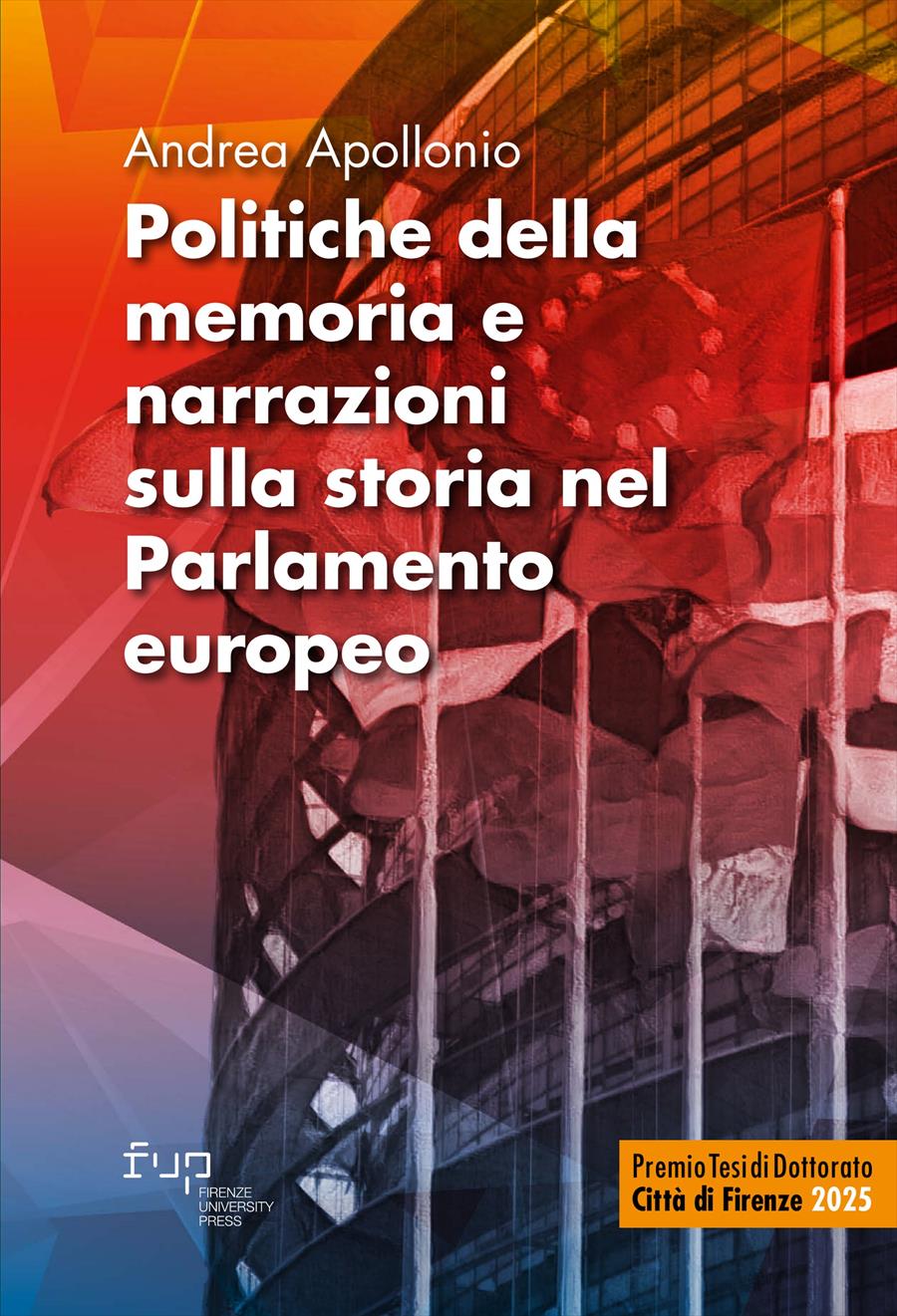
Politiche della memoria e narrazioni sulla storia nel Parlamento europeo
- Andrea Apollonio,
This book presents a qualitative study of the European Parliament's memory politics, integrating EU studies and memory studies through a sociological, actor-centred approach. At the theoretical level, it develops original conceptual tools – most notably that of "intra-institutional memory activism" – through a critical literature review. Combining fieldwork, semi-structured interviews, and document collection, the book reconstructs the evolution of EU memory politics, highlighting their main discursive shifts. Focusing on the 9th legislature of the EP, it analyses the forms of memory entrepreneurship underlying these transformations, emphasising the role of informal political networks and the contribution of non-political actors, such as expert officials.
- Keywords:
- memory politics,
- collective memory,
- symbolic legitimacy,
- political narratives,
- European Union,
- DOI: 10.36253/979-12-215-0996-0
- Series: Premio Tesi di Dottorato Città di Firenze
- Scientific Board: Premio Tesi di Dottorato Città di Firenze 2025
- Language: Italian
- Subjects: Sociology
- ORCID: 0000-0002-1887-9055
Andrea Apollonio
Gli orizzonti della ricerca: status quaestionis e strumenti concettuali- CC BY 4.0 |
- © Author(s)
-

pp.13-51
Andrea Apollonio
Le politiche europee della memoria e il discorso sulla memoria storica europea: contesto ed evoluzione- CC BY 4.0 |
- © Author(s)
-
pp.67-116
Andrea Apollonio
Caso di studio I: la risoluzione su “L’importanza della memoria europea per il futuro dell’Europa”- CC BY 4.0 |
- © Author(s)
-
pp.117-151
Andrea Apollonio
Caso di studio II: la risoluzione su “La coscienza storica europea”- CC BY 4.0 |
- © Author(s)
-
pp.153-183
- Anderson, B. (1991). Imagined communities. Reflections on the origin and spread of nationalism. New York: Verso [1983].
- Apollonio, A. (2025). Intra-institutional memory activism: a sociological investigation of the European Parliament’s politics of remembrance. Journal of Contemporary European Studies, 1–18. DOI: 10.1080/14782804.2025.2597782
- Apollonio, A., & Ventura, R. A. (2025). The Fractured Legacy of Antitotalitarianism: Political Usage of a Discursive Frame in EU Memory Politics and Beyond. De Europa, 8(1), 97-114. DOI: 10.13135/2611-853X/12373
- Appadurai, A. (1981). The Past as a Scarce Resource. Man, vol. 16, n. 2, 203-19. DOI: 10.2307/2801395
- Appadurai, A. (2012). Modernità in Polvere, Milano: Raffaello Cortina Editore.
- Assmann, A. (2002). Ricordare, forme e mutamenti della memoria culturale. Bologna: Il Mulino.
- Assmann, A. (2007). Europe: a community of memory? GHI bulletin, n. 40, 11-25.
- Assmann, A. (2008). Transformations between History and Memory. Social Research, vol. 75, n. 1, 49–72. DOI: 10.1353/sor.2008.0038
- Assmann, A. (2011). Europe’s divided memory. In M. Blaive, C. Gerbel & T. Lindenberger (A cura di), Clashes in European Memory. The Case of Communist Repression and the Holocaust (pp. 270-280), Innsbruck, StudienVerlag.
- Assmann A. (2014). Transnational Memories. European Review, vol. 22, n. 4, 546-556. DOI: 10.1017/S1062798714000337
- Assmann, J (1997). La memoria culturale. Scrittura, ricordo e identità politica nelle grandi civiltà antiche. Torino: Giulio Einaudi Editore.
- Bacian, I. & Eisele, K. (2023). Early implementation of four 2021-2027 EU programmes: Erasmus +, Creative Europe, European Solidarity Corps, and Citizens, Equality, Rights and Values (Strand 3). EPRS study, European Union.
- Baldissara, L. (2016). Politiche della memoria e spazio del ricordo in Europa. Rivista Il Mulino, n. 1, 6-20.
- Barile, D. (2021). Memory and the integration. The European parliament’s 2019 resolution on European remembrance as a case study. Journal of European Integration, vol 43 n. 8, 989-1004. DOI: 10.1080/07036337.2021.1903890
- Bauman, Z. (2004). L’Europa è un’avventura. Roma-Bari: Editori Laterza.
- Bauman, Z. (2019). Oltre le nazioni. L’Europa tra sovranità e solidarietà. Roma-Bari: Editori Laterza.
- Beattie, A. (2007). Learning from the Germans? History and Memory in German and European Projects of Integration. PORTAL Journal of Multidisciplinary International Studies, Vol. 4, N. 2, 1–21. DOI: 10.5130/portal.v4i2.483
- Beck, U. & Grande, E. (2006). L’Europa Cosmopolita. Società e politica nella seconda modernità. Roma: Carocci.
- Beck, U. (2002). The cosmopolitan society and its enemies. Theory, Culture & Society, vol. 19, n. 1-2, 17-44. DOI: 10.1177/026327640201900101
- Beck, U. (2012). La Crisi dell’Europa. Bologna: Il Mulino.
- Bellagamba, A. & Paini, A. (1999). Costruire il passato. Il Dibattito sulle tradizioni in Africa e in Oceania. Torino: Paravia-scriptorium.
- Bellagamba, A. (2019). Futuri passati: la frontiera in divenire fra antropologia e storia. Antropologia, vol. 6, n. 1, 277-297.
- Belluati, M. & Marini, R. (2019). Ripensare all'Unione Europea. La nuova ecologia del suo spazio comunicativo. Problemi dell'informazione, Rivista quadrimestrale, n. 1, 3-28. DOI: 10.1445/92853
- Benocci, B. & Verderame, D. (2020). ‘Native Europeans’ and European Memories. The building of a European consciousness among young people. De Europa, 3(2), 92-105. DOI: 10.13135/2611-853X/4523
- Berger, P. L., & Luckmann, T. (1966). The social construction of reality: A treatise in the sociology of knowledge. Garden City, NY: Anchor Books
- Berliner, D. (2005). The Abuses of Memory: Reflections on the Memory Boom in Anthropology. Anthropological Quarterly, vol. 78, n.1, 197-211. DOI: 10.1353/anq.2005.0001
- Blaive, M., & Gerbel, C. (2010). Clashes In European Memory: The Case of Communist Repression and the Holocaust. Innsbruck: Studienverlag.
- Bloch, M. (1925). Memoire collective, tradition, et coutume: à propos d’un livre récent. Revue de synthèse historique, vol. 40, 74-83. DOI: 10.1163/24199893-0400103008
- Bloch, M. (1952). Apologie Pour L’histoire Ou Métier D’historien. Cahier des Annales, Paris: Librairie Armand Colin [1949].
- Bobba, G. (2021). L’Europa Contestata. Polarizzazione e politicizzazione delle opinioni in tempi di crisi. Bologna: Il Mulino.
- Bolaffi, A. & Crainz, G. (2019). Calendario civile europeo. I nodi storici di una costruzione difficile. Roma: Donzelli Editore.
- Bond, L. & Rapson, J. (2014). The Transcultural Turn: Interrogating Memory Between and Beyond Borders. Berlin, Boston: De Gruyter. DOI: 10.1515/9783110337617
- Boschetti, L. (2020). L’affermazione di un nuovo modello memoriale? In P. Martino (a cura di), Nazismo, Comunismo, Antifascismo. Memorie e Rimozioni d’Europa (pp. 153-184). Bari: Edizioni Radici Future.
- Bossuat, G. (1999). Des lieux de mémoire pour l’Europe unie. Vingtième Siècle. Revue d’histoire, n.61, 56-69. DOI: 10.3917/ving.p1999.61n1.0056
- Bottici, C., & Challand, B. (2013). Imagining Europe: Myth, memory, and identity. Cambridge University Press. DOI: 10.1017/CBO9781139059015
- Bourdieu, P. (1972). Esquisse d'une théorie de la pratique, précédé de trois études d'ethnologie kabyle. Genève: Droz. DOI: 10.3917/droz.bourd.1972.01
- Bourdieu, P. (2022). Microcosmes. Théorie des champs. Paris: Raisons d'agir.
- Bouza Garcia, L. (2017). The ‘new narrative project’ and the politicisation of the EU. Journal of Contemporary European Studies, vol. 25, n. 3, 340–353. DOI: 10.1080/14782804.2017.1348340
- Bryman, A. (2008). Social Research Methods. Oxford: Oxford University Press.
- Buettner, E. (2018). What–and who–is ‘European’ in the Postcolonial EU? Inclusions and Exclusions in the European Parliament’s House of European History. BMGN-Low Countries Historical Review, vol. 133, n. 4, 132-148. DOI: 10.18352/bmgn-lchr.10615
- Caiani, M., Guerra, S. (2017). Euroscepticism, Democracy and the Media. London: Palgrave Macmillan. DOI: 10.1057/978-1-137-59643-7
- Calligaro, O. & Foret, F. (2012). La Mémoire européenne en action. Acteurs, enjeux et modalités de la mobilisation du passé comme ressource politique pour l’Union européenne. Politique européenne, vol. 37, n. 2, 18-43. DOI: 10.3917/poeu.037.0018
- Calligaro, O. (2015). Legitimation Through Remembrance? The Changing Regimes of Historicity of European Integration. Journal of Contemporary European Studies, Vol. 23, n. 3, 330-343. DOI: 10.1080/14782804.2015.1054794
- Calligaro, O. (2021). European identity between culture and values: From European heritage to “our European way of life. In F. Foret & J. Vargovčíková (A cura di), Value politics in the European Union. From market to culture and back. London: Routledge, 133-150. DOI: 10.4324/9781003153863-10
- Calveiro, P. (2006). Los usos políticos de la memoria. In G. Caetano (a cura di), Sujetos sociales y nuevas formas de protesta en la historia reciente de América Latina. Buenos Aires: CLACSO.
- Candau, J. (1996). Anthropologie de la mémoire. Paris: Presses universitaires de France.
- Candau, J. (2006). La Memoria e l’identità. Ipermedium Libri, 2002.
- Cardano, M. (2011). La ricerca qualitativa. Bologna: Il Mulino.
- Cardano, M., & Gariglio, L. (2022). Metodi qualitativi. Pratiche di ricerca in presenza, a distanza e ibride. Roma: Carocci.
- Cavalli, A. & Martinelli, A. (2015). La Società Europea. Bologna: Il Mulino.
- Cavalli, A. (1991). Lineamenti di una sociologia della memoria. In P. Jedlowski & M. Rampazi (A cura di), Il senso passato. Saggi per una sociologia della memoria (pp. 31-42).
- Čeginskas, V. L. A., Kaasik-Krogerus, S., & Sääskilahti, N. (2022). Politics of Memory and Oblivion in the European Context. Critical Perspectives. New York: Routledge. DOI: 10.4324/9781003231370
- Cerutti, F. (2008). Why political identity and legitimacy matter in the European Union, in F. Cerutti, S. Lucarelli (a cura di), The search for a European Identity. Values, Policies and Legitimacy of the European Union (pp. 12-13). London: Routledge.
- Charléty, V. (2006). Reperes fondateurs. Introduire l'histoire dans l'espace public européen. Politique européenne, vol. 18, no. 1, 17-47. DOI: 10.3917/poeu.018.0017
- Christiansen, T. & Neuhold, C. (2013). Informal politics in the EU. Journal of Common Market Studies, vol. 51, n. 6, 1196-1206. DOI: 10.1111/jcms.12068
- Climo, J. & Cattell M. (2002). Social Memory and History: anthropological perspectives. Walnut Creek, Lanham, New York, Oxford: Altamira Press.
- Cohen, A. (2007). Le « père de l'Europe ». La construction sociale d'un récit des origines. Actes de la recherche en sciences sociales, vol. 166-167, no. 1-2, 14-29. DOI: 10.3917/arss.166.0015
- Cohen, A. P. (1985). The symbolic construction of community. London: Routledge. DOI: 10.4324/9780203323373
- Connerton, P. (1999). Come le società ricordano. Roma: Armando Editore.
- Connerton, P. (2010). Come la modernità dimentica. Torino: Einaudi.
- Constantin, C. (2013). Pour une socio-histoire de la catégorie de père de l'Europe et ses usages pluriels: trajectoires, réputations, mémoires (1950-2010). Tesi di dottorato, Paris: EHESS.
- Conti, D. (2020). Crisi europea e “populismo storico”. in Martino, P. (A cura di), Nazismo, comunismo, antifascismo. Memorie e rimozioni d’Europa. Bari: Radici Future, 2020.
- Contini, G. (1997). La memoria divisa. Milano: Rizzoli.
- Corbetta, P. (2011). La Ricerca Sociale. Metodologia e Tecniche. III: Le Tecniche Qualitative. Bologna: Il Mulino.
- Coser, L. (1992), Introduction. In M. Halbwachs, On Collective Memory, Chicago: University of Chicago Press (pp. 1–34).
- Crainz, G., Pupo, R. & Salvatici, S. (2008). Naufraghi della pace. Il 1945, i profughi e le memorie divise d'Europa. Roma: Donzelli.
- Creswell, J. W. (2014). Research Design. Qualitative, Quantitative and Mixed Methods Approaches. Los Angeles, London, New Delhi, Singapore: Sage.
- Crouch, C. (2016). Society & Social Change in 21st Century Europe. London: Palgrave. DOI: 10.1057/978-1-137-27782-4
- De Cesari C., Rigney, A. (2014). Transnational Memory. Circulation, Articulation, Scales. Berlin, Boston: De Gruyter. DOI: 10.1515/9783110359107
- de Wilde, P. (2011). No Polity for Old Politics? A Framework for Analyzing the Politicization of European Integration. Journal of European Integration, vol. 33, n. 5, 559-575. DOI: 10.1080/07036337.2010.546849
- Dei, F. (2018). Usi del passato e democratizzazione della memoria: il caso delle rievocazioni storiche. In A. Iuso, Il Senso della storia. Saperi diffusi e patrimonializzazione del passato. Roma: CISU.
- Delanty, G. (2003). Is there a European Identity? Global Dialogue, 5, 3-4.
- Delanty, G. (2017). Entangled memories: how to study Europe’s cultural heritage. The European Legacy, vol. 22, n. 2, 129-145. DOI: 10.1080/10848770.2016.1260269
- Delanty, G. & Rumford, C. (2005). Rethinking Europe. London-New York: Routledge. DOI: 10.4324/9780203640050
- Della Porta, D. & Caiani, M. (2006). Quale Europa? Europeizzazione, identità e conflitti. Bologna: Il Mulino.
- Della Porta, D. (2010). L’intervista qualitativa. Roma-Bari: Editori Laterza.
- Della Sala, V. (2010). Political Myth, Mythology and the European Union. Journal of Common Market Studies, vol.48, n. 1, 1–19. DOI: 10.1111/j.1468-5965.2009.02039.x
- Den Boer, P. (1993). Lieux de mémoire et identité de l’Europe. In P. Den Boer, & W. Frijhoff, (A cura di), Lieux de mémoire et identités nationales (pp.11-29). Amsterdam: Amsterdam University Press.
- Deschamps, É. (2022). The Jean Monnet House: A place of European memory. EPRS, European Parliamentary Research Service.
- Di Pasquale, C. (2019). Antropologia della memoria. Il ricordo come fatto culturale. Bologna: Il Mulino.
- Diner, D. (2003). Restitution and Memory: The Holocaust in European Political Cultures. New German Critique, n. 90, 36-44. DOI: 10.2307/3211106
- Doni, M. & Migliorati, L. (2011). La Forza Sociale della Memoria. Esperienze, Culture, Confini. Roma: Carocci.
- Drachenberg, R. (2024). European Parliament's scrutiny of the European Council: The use of Parliament resolutions. EPRS, European Parliamentary Research Service.
- Droit, E. (2007). The Gulag and the Holocaust in Opposition: Official Memories and Memory Cultures in an Enlarged Europe. Vingtième siècle. Revue d’histoire, vol. 94, n. 2, 101-120. DOI: 10.3917/ving.094.0101
- Duara, P. (1995). Rescuing History from the Nation: Questioning Narratives of Modern China. Chicago: Univ. Chicago Press. DOI: 10.7208/chicago/9780226167237.001.0001
- Dujisin, Z. (2021). A history of post-communist remembrance: from memory politics to the emergence of a field of anticommunism. Theory and Society, 50, 65–96. DOI: 10.1007/s11186-020-09401-5
- Edelman, M. (1987). Gli usi simbolici della politica. Napoli: Guida Editori.
- Eder, K. & Trenz, H. (2004). The Democratizing Dynamics of a European Public Sphere: Towards a Theory of Democratic Functionalism. European Journal of Social Theory, vol. 7, n. 1, 5-25. DOI: 10.1177/1368431004040016
- Eder, K. (2005). Remembering National Memories Together: The Formation of a Transnational Identity in Europe. in W. Spohn & K. Eder (A cura di), Collective memory and European Identity. The effects of integration and enlargement (pp. 197-220), Routledge.
- Elomäki, A., & Haapala, T. (2024). Politics of expertise in the European Parliament: Discursive constructions and contestations of expertise by party-political actors. Journal of European Integration, vol. 45, n. 2, 1-20. DOI: 10.1080/07036337.2023.2283699
- Emmons, C. & Pavone, T. (2021). The rhetoric of inaction: failing to fail forward in the EU’s rule of law crisis. Journal of European Public Policy, vol. 28, n. 10, 1611-1629. DOI: 10.1080/13501763.2021.1954065
- European Commission. (2010). Let’s act today for the Europe of tomorrow — Europe for citizens Programme 2007/2013. Luxembourg: Publications Office of the European Union.
- European Commission (2013). The Founding Fathers of Europe. Luxembourg: Publications Office of the European Union.
- Eyal, G. (2019). The Crisis of Expertise. Cambridge: Polity Press.
- Fabbrini, S. (2017). Sdoppiamento. Una prospettiva nuova per l’Europa. Roma-Bari: Editori Laterza.
- Fabbrini, S. (2019). I nodi irrisolti di un’“Europa più grande”. In A. Bolaffi & G. Crainz (A cura di), Calendario civile europeo. I nodi di una costruzione difficile (pp. 391-397). Roma: Donzelli Editore.
- Fabietti, U. & Matera, V. (2018). Memorie e Identità, simboli e strategie del ricordo. Milano: Meltemi Editore.
- Flockhart, T. (2010). Europeanization or EU-ization? The Transfer of European Norms across Time and Space. Journal of Common Market Studies, vol. 48, n. 9, 787–810. DOI: 10.1111/j.1468-5965.2010.02074.x
- Focardi, F. & Groppo, B. (2013). L’Europa e le sue memorie. Politiche e culture del ricordo dopo il 1989. Roma: Viella.
- Focardi, F. (2019). The dispute over the past. Political transition and memory wars in Italy, from the crisis of the First Republic until the present day. Observing Memories, EUROM, n.3, 34-43.
- Fogu C., Kansteiner W. (2006). The Politics of Memory and the Poetics of History. In Lebow R. N., Kansteiner W., Fogu C. (A cura di), The Politics of Memory in Postwar Europe (pp. 284-310). Durham and London: Duke University Press. DOI: 10.2307/j.ctv11cw204.12
- Foret, F. (2008). Légitimer l'Europe, Pouvoir et symbolique à l'ère de la gouvernance. Paris: Presses de Sciences Po. DOI: 10.3917/scpo.foret.2008.01
- Foret, F. (2010). European political rituals: A challenging tradition in the making. International political anthropology, vol. 3, n. 1, 55-77.
- Foret, F. (2015). Religion and politics in the European Union. Cambridge University Press. DOI: 10.1017/CBO9781316014301
- Foret, F. (2025). The European Union in search of narratives: Disenchanted Europe? London & New York: Routledge. DOI: 10.4324/9781003585121
- Foret, F. & Calligaro, O. (2019). Governing by prizes: how the European Union uses symbolic distinctions in its search for legitimacy. Journal of European Public Policy, vol. 26, n. 9, 1335-1353. DOI: 10.1080/13501763.2018.1523221
- Foret, F. & Trino, N. (2023). The ‘European way of life’, a new narrative for the EU? Institutions’ vs citizens’ view. European Politics and Society, vol. 24, n. 3, 336-353. DOI: 10.1080/23745118.2021.2020482
- Foucault, M. (1977). Language, Counter- Memory, Practice: Selected Essays and Interviews. Ithaca, New York: Cornell Univ. Press.
- Garcia, B. & Cox, T. (2013). European capitals of culture: Success strategies and long-term effects. Policy dep. B -Structural and cohesion policies, CULT, European Parliament.
- Gedi, N. & Elam, Y. (1996). Collective memory - what is it? History and Memory, vol. 8, n. 2, 30–50.
- Gensburger, S. & Lavabre, M. (2012). D’une « mémoire » européenne à l’européanisation de la « mémoire ». Politique Européenne, L’Harmattan, vol. 37, n. 2, 9-17. DOI: 10.3917/poeu.037.0009
- Gensburger, S. (2020). Can the Past change the Future? A sociological reflection on memory policies, Observing Memories, EUROM, n. 4, 40-47. DOI: 10.1007/978-3-030-34202-9_3
- Giddens, A. (1984), The constitution of society: Outline of the theory of structuration. Cambridge: Polity Press.
- Giddens, A. (2007). L’Europa nell’età globale. Roma-Bari: Editori Laterza.
- Goddard, V. A., Llobera, J. R. & Shore, C. (1994). The anthropology of Europe, identities and boundaries in conflict. Oxford: Providence.
- Gongaware, T. B. (2011). Keying the past to the present: Collective memories and continuity in collective identity change. Social Movement Studies: Journal of Social, Cultural and Political Protest, vol. 10, n. 1, 39-54. DOI: 10.1080/14742837.2011.545226
- Grande, T. & Affuso, O. (2012). M come memoria. La memoria nella teoria sociale. Napoli: Liguori.
- Grande, T. (2001). Le origini sociali della memoria. in A. L. Tota (A cura di), La memoria contesa. Studi sulla comunicazione sociale del passato (pp. 68-85). Milano: FrancoAngeli.
- Grande, T. (2009). Quale memoria per l'Europa? In L. Basevi, Rammemorare la Shoah. 27 gennaio e identità europea (pp. 51-67). Soveria Mannelli: Rubbettino.
- Grande, T. (2011). L’Europa tra memorie comuni e memoria autocritica. in M. Doni, & L. Migliorati (A cura di), La Forza Sociale della Memoria. Esperienze, Culture, Confini. Roma: Carocci.
- Grau i Segú, M. (2020). European Parliament public history initiatives and the memory of European unity: some reflections and a blueprint for action. RiMe, Rivista dell’Istituto di Storia dell’Europa Mediterranea, vol. 7, n. II, 113-137.
- Guiraudon, V., Favell, A. (2011). The sociology of European Union. London: Palgrave Macmillan.
- Guisan, C. (2011). A Political Theory of Identity in European Integration: Memory and policies (1st ed.). London and New York: Routledge.
- Gürkan, S. & Terzi, Ö. (2024). Emotions in EU foreign policy – when and how do they matter? Journal of European Integration, vol. 46, n. 5, 575–596. DOI: 10.1080/07036337.2024.2360697
- Gutman, Y., & Wüstenberg, J. (2022). Challenging the meaning of the past from below: A typology for comparative research on memory activists, in «Memory Studies», vol. 15, n. 5, 1070–1086. DOI: 10.1177/17506980211044696
- Gutman, Y. & Wüstenberg, J. (2023). The Routledge Handbook of Memory Activism. London and New York: Routledge. DOI: 10.4324/9781003127550
- Habermas, J. (1984). Storia e critica dell’opinione pubblica. Roma-Bari: Editori Laterza [1962].
- Habermas, J. (1988). Concerning the Public Use of History. New German Critique, No. 44, Special Issue on the Historikerstreit, 40-50. DOI: 10.2307/488145
- Habermas, J. (2006). Political communication in media society: Does democracy still enjoy an epistemic dimension? The impact of normative theory on empirical research. Communications Theory, vol. 16, n. 4, 411-424. DOI: 10.1111/j.1468-2885.2006.00280.x
- Habermas, J. (2007). La Condizione Intersoggettiva. Roma-Bari: Editori Laterza [2005].
- Habermas, J. (2009). Europe: The Faltering Project. London: Polity Press.
- Habermas, J. (2012). Questa Europa è in crisi. Roma-Bari: Editori Laterza [2011].
- Habermas, J. (2014). Nella spirale tecnocratica. Un’arringa per la solidarietà europea. Roma-Bari: Editori Laterza [2013].
- Halbwachs, M. (1941). La Topographie légendaire des Évangiles en Terre sainte. Étude de mémoire collective. Paris: Presses Universitaires de France.
- Halbwachs, M. (1992). On Collective Memory. Chicago: University of Chicago Press. DOI: 10.7208/chicago/9780226774497.001.0001
- Halbwachs, M. (1997). I quadri sociali della memoria. Napoli: Ipermedium [1925].
- Hansen-Magnusson, H. & Wüstenberg, J. (2012). Commemorating Europe? Forging European Rituals of Remembrance through Anniversaries. Politique européenne, vol. 2, n. 37, 44-70. DOI: 10.3917/poeu.037.0044
- Hartog, F. (2007). Regimi di storicità. Palermo: Sellerio editore.
- Heurtaux, J. & Pellen, C. (2009). 1989 à l’Est de l’Europe. Une mémoire controversée, La Tour d’Aigues: Éditions de L’Aube.
- Hilmar, T. (2016). Narrating Unity at the European Union's New History Museum: A Cultural-Process Approach to the Study of Collective Memory. European Journal of Sociology, vol. 57, n. 2, 297-329. DOI: 10.1017/S0003975616000114
- Hix, S. & Bartolini, S. (2006). La politisation de l’UE: remède ou poison?. Notre Europe Policy Paper, 19.
- Hobsbawm, E. (1972). The social function of the past: some questions. Past Present, 55, 3-17. DOI: 10.1093/past/55.1.3
- Hobsbawm, E. & Ranger, T. (1983). The Invention of Tradition. New York: Cambridge Univ. Press.
- Hodgkin, C. & Radstone, S. (2003). Introduction: contested pasts. In C. Hodgkin, e S. Radstone (A cura di), Contested Pasts. The politics of memory, London & New York: Routledge. DOI: 10.4324/9780203391471
- Hooghe, L. & Marks, G. (2009). A Postfunctionalist Theory of European Integration: From Permissive Consensus to Constraining Dissensus. British Journal of Political Science, vol. 39, n. 1, 1-23. DOI: 10.1017/S0007123408000409
- Houde, A., Laloux, T., Le Corre Juratic, M., Mercenier, H., Pennetreau, D., Versailles, A. (2023). The Politicization of the European Union. From Processes to Consequences. Bruxelles: Éditions de l’Université de Bruxelles.
- Huyssen, A. (1995). Twilight memories: Marking time in a culture of amnesia. London and New York: Routledge.
- Huyssen, A. (2003). Present Pasts: Urban Palimpsests and the Politics of Memory. Stanford University Press. DOI: 10.1515/9781503620308
- Imig, D. & Tarrow, S. (2001). Political contention in a Europeanizing Polity. In id. (A cura di) Contentious Europeans: Protest and Politics in an Emerging Polity. Lanham: Rowman and Littlefield.
- Jaspers, K. (1996). La questione della colpa. Sulla responsabilità politica della Germania. Milano: Raffaello Cortina Editore.
- Jedlowski, P. (2001). Memory and Sociology: themes and issues. Time & Society, Vol 10, n. 29, 29-44. DOI: 10.1177/0961463X01010001002
- Jedlowski, P. (2002). Memoria, esperienza e modernità. Memorie e società nel XX secolo. Milano: FrancoAngeli.
- Jedlowski, P. (2009). Il racconto come dimora, Heimat e le memorie d’Europa. Torino: Bollati Boringhieri.
- Jedlowski, P. (2011). Cinema europeo e memorie autocritiche. Quaderni di Sociologia, n. 55. DOI: 10.4000/qds.651
- Jedlowski, P. (2016). Intenzioni di memoria, Sfera pubblica e memoria autocritica. Sesto San Giovanni: Mimesis.
- Jedlowski, P. (2017). Memorie del futuro. Un percorso tra sociologia e studi culturali. Roma: Carocci editore.
- Jedlowski, P. (2020). Memoria Storica, in Enciclopedia Italiana di Scienze, Lettere e Arti, X appendice, Parole del XX Secolo, Treccani.
- Johnson, R., McLennan, G., Schwarz, B., & Sutton, D. (1982). Making histories: Studies in history-writing and politics. London: Hutchinson in association with the Centre for Contemporary Cultural Studies, University of Birmingham.
- Judt, T. (1992). The Past is Another Country: Myth and Memory in Postwar Europe. Dædalus, vol. 121, n. 4, 83-118.
- Judt, T. (2005). Postwar: A History of Europe since 1945. London: William Heinemann.
- Kaiser, W. (2012). The European Parliament as an Institutional Memory Entrepreneur. in L. Bekemans (A cura di), A Value-Driven European Future (pp. 113-124). Brussels: P.I.E. Peter Lang.
- Kaiser, W. (2021). Victimizing Europeans: Narrating Shared History in the European Parliament’s House of European History, Politique Européenne, Vol. 71, N. 1, 54-78. DOI: 10.3917/poeu.071.0054
- Kaiser, W. (2022). European Day of Remembrance for Victims of all Totalitarian and Authoritarian Regimes. EPRS, European Parliamentary Research Service.
- Kansteiner, W. (2002). Finding meaning in memory: A methodological critique of collective memory studies. History and theory, 41(2), 179-197. DOI: 10.1111/0018-2656.00198
- Kauppi, N. & Trenz, H. (2021). Notes on the “Politics” of EU Politicisation. ARENA Centre for European Studies – Working paper (online).
- Kauppi, N. (2005). Democracy, Social Resources and Political Power in the European Union. Manchester: Manchester University Press.
- Kauppi, N. (2013). A Political Sociology of Transnational Europe. Colchester: ECPR Press.
- Kauppi, N. (2018). Toward a Reflexive Political Sociology of the European Union. Cham: Palgrave. DOI: 10.1007/978-3-319-71002-0
- Kauppi, N. (2022). The Political Field of the European Union. In S. M. Büttner, M. Eigmüller & S. Worschech (A cura di), Sociology of Europeanization (pp. 215-234). Berlin, Boston: De Gruyter Oldenbourg. DOI: 10.1515/9783110673630-009
- Kelam, T. (2009). Applying Equality and Common Values to the Perception of the European history: Suggestions on Assessment of Totalitarian Communism. Speech by the Estonian MEP at the European Parliament conference United Europe, United History, 22 January.
- Kelemen, R. D. (2024). Will the European Union escape its autocracy trap? Journal of European Public Policy, 1-24. DOI: 10.1080/13501763.2024.2314739
- Killingsworth, M., Klatt, G. & Auer, S. (2010). Where does Poland fit in Europe? How Political Memory influences Polish MEPs’ Perceptions of Poland’s Place in Europe. Perspectives on European Politics and Society, vol. 11, n. 4, 358-375. DOI: 10.1080/15705854.2010.524408
- Kleine, M. (2013). Informal Governance in the European Union: How Governments Make International Organizations Work. Ithaca, New York: Cornell University Press. DOI: 10.7591/cornell/9780801452116.001.0001
- Kohli, M. (2000). The battleground of European Identity. European Societies, vol. 2, n. 2, 113-137. DOI: 10.1080/146166900412037
- Koselleck, R. (2007). Futuro passato. Per una semantica dei tempi storici. Bologna: CLUEB.
- Koshar, R. (1994). CHAPTER XI. Building Pasts: Historic Preservation and Identity in Twentieth - Century Germany. In J. Gillis (A cura di), Commemorations: The Politics of National Identity (pp. 215-238). Princeton: Princeton University Press. DOI: 10.1515/9780691186658-014
- Kubik, J., & Bernhard, M. (2014). A Theory of the Politics of Memory. In J. Kubik, & M. Bernhard (A cura di), Twenty years after communism: The politics of memory and commemoration (pp. 7-37). Oxford: Oxford University Press. DOI: 10.1093/acprof:oso/9780199375134.003.0002
- Kucia, M. (2016). The europeanization of Holocaust memory and Eastern Europe. East European politics and societies, vol. 30, n. 1, 97-119. DOI: 10.1177/0888325415599195
- Lagrou, P. (2011). Europe as a Place for Common Memories? Some thoughts on Victimhood, Identity and Emancipation from the Past. In Blaive, M., Gerbel, C. & Lindenberger, T. (A cura di), Clashes in European Memory. The Case of Communist Repression and the Holocaust (p. 281). Innsbruck: StudienVerlag.
- Lagrou, P. (2013). L’Europa come luogo di memoria comune? In F. Focardi, Filippo & B. Groppo (a cura di), L’Europa e le sue memorie. Politiche e culture del ricordo dopo il 1989 (p. 267). Roma: Viella.
- Lähdesmäki, T. (2019). Founding myths of European Union Europe and the workings of power in the European Union heritage and history initiatives. European Journal of Cultural Studies, Vol 22, n. 5/6, 781-798. DOI: 10.1177/1367549418755921
- Landorff, L. (2019). Inside European Parliament Politics. Cham: Palgrave. DOI: 10.1007/978-3-030-04206-6
- Langenbacher E. (2012). A Plea for an “Intergovernamental” European Memory. In Langenbacher, E., Niven, B., & Wittlinger, R. (A cura di), Dynamics of Memory and Identity in Contemporary Europe. Oxford – New York: Berghahn Books. DOI: 10.3167/9780857455772
- Langenbacher, E. & Shain, Y. (2010). Power and the past: Collective Memory and International Relations. Washington, DC: Georgetown University Press.
- Langenbacher, E., Niven, B. & Wittlinger, R. (2012). Dynamics of Memory and Identity in Contemporary Europe. Oxford, New York: Berghahn Books. DOI: 10.3167/9780857455772
- Larat, F. (2005). Present-ing the Past: Political Narratives on European History and the Justification of EU Integration. German Law Journal, vol. 6, n. 2-1, 273-290. DOI: 10.1017/S2071832200013638
- Le Goff, J. (1982). Storia e memoria. Torino: Einaudi.
- Lebow, R. N. (2006). The Memory of Politics in Postwar Europe. In R. N. Lebow, W. Kansteiner & C. Fogu (A cura di), The Politics of Memory in Postwar Europe (pp. 1-39). Durham, NC and London: Duke University Press. DOI: 10.1215/9780822388333
- Lebow, R. N. (2008). The future of memory. The annals of the American academy of political and social science, vol. 617, n. 1, 25-41. DOI: 10.1177/0002716207310817
- Lebow R. N., Kansteiner W. & Fogu C. (2006). The Politics of Memory in Postwar Europe. Durham and London: Duke University Press. DOI: 10.1215/9780822388333
- Leggewie, C. (2008). A Tour of the Battleground: The Seven Circles of Pan-European Memory. Social Research, vol. 75, no. 1, 217–34. DOI: 10.1353/sor.2008.0036
- Leggewie, C. (2009). Battlefield Europe. Transitional memory and European identity, Eurozine.
- Leonardi, L. (2007). Opening the European Box. Towards a new sociology of Europe. Firenze: Firenze University Press. DOI: 10.36253/978-88-8453-593-1
- Leonardi, L. (2012). La società europea in costruzione. Trasformazioni sociali e integrazione europea. Firenze: Firenze University Press. DOI: 10.36253/978-88-6655-252-9
- Leonardi, L. (2018). La Crisi dell’Europa. La “distruzione creativa” e le nuove solidarietà sociali. CSE working papers 18/02.
- Leonardi, L. (2020). Tracce di un rinascimento dell’Europa? La società europea tra conflitti di valore e sfide globali. Bologna: Il Mulino.
- Leonardi, L., Scalise, G. (2019). Social challenges for Europe. Addressing failures and perspectives of the European project. Bologna: Il Mulino.
- Lévi-Strauss, C. (1980). Identità. Palermo: Sellerio Editore.
- Lévi-Strauss, C. (2016). Mito e Significato. Milano: Il Saggiatore.
- Levy, D. & Sznaider, N. (2002). Memory Unbound: The Holocaust and the Formation of Cosmopolitan Memory. European Journal of Social Theory, vol. 5, n. 1, 87-106. DOI: 10.1177/13684310222225315
- Lipsitz, G. (1990). Time passages: Collective memory and American popular culture. University of Minnesota Press
- Littoz-Monnet, A. (2012). The EU Politics of Remembrance: Can Europeans Remember Together? West European Politics, vol. 35, n. 5, 1182-1202. DOI: 10.1080/01402382.2012.706416
- Littoz-Monnet, A. (2013). Explaining Policy Conflict Across Institutional Venues: European Union-Level Struggles Over the Memory of the Holocaust. Journal of Common Market Studies, vol. 51, n. 3, 489-504. DOI: 10.1111/j.1468-5965.2012.02317.x
- Lowenthal, D. (1985). The Past is a foreign country. Cambridge: Cambridge University Press. DOI: 10.2307/20042674
- Maier, C. S. (2002). Hot Memory ... Cold Memory. On the Political Half-Life of Fascist and Communist Memory. Transit - European Revue, n.22, 153-165.
- Malighetti, R. (2004). Il Quilombo di Frechal. Identità e lavoro sul campo in una comunità brasiliana di discendenti di schiavi. Milano: Raffaello Cortina Editore.
- Mälksoo, M. (2014). Criminalizing Communism: Transnational Mnemopolitics in Europe. International Political Sociology, vol. 8, n 1, 82-99. DOI: 10.1111/ips.12041
- Mälksoo, M. (2023). Handbook on the politics of memory. Cheltenham: Edward Elgar Publishing. DOI: 10.4337/9781800372535
- Mälksoo, M. (2023). Politics of memory: a conceptual introduction. In M. Mälksoo (A cura di), Handbook on the politics of memory (pp. 1-16). Cheltenham: Edward Elgar Publishing. DOI: 10.4337/9781800372535.00006
- Martin, P. (2009). Des lieux de mémoire pour l’Europe: une mission impossible? In B. Majeurs et al. (A cura di), Dépasser le cadre national des « lieux de mémoire ». Innovations méthodologiques, approches comparatives, lectures transnationales (pp. 155-174). Bruxelles: Peter Lang.
- Martino, P. (2020). Nazismo, comunismo, antifascismo. Memorie e rimozioni d’Europa. Bari: Radici Future, 2020.
- Martino, P. (2020). Introduzione. Verità della storia e uso politico della memoria. In P. Martino (A cura di), Nazismo, comunismo, antifascismo. Memorie e rimozioni d’Europa (p. 9). Bari: Radici Future.
- Matsuda, M. K. (1996). The Memory of the Modern. New York: Oxford Univ. Press. DOI: 10.1093/oso/9780195093643.001.0001
- Melucci, A. (1996). Memoria, solidarietà, identità. In F. Cerruti (a cura di), Identità e politica, Roma-Bari: Editori Laterza.
- Middleton, D. & Edwards, D. (1990). Collective Remembering. Newbury Park, California: Sage.
- Milošević, A. & Truc, G. (2021). (Un)shared memory: European Parliament and EU Remembrance Day for Victims of Terrorism. Politique européenne, n. 71, 142-169. DOI: 10.3917/poeu.071.0142
- Milošević, A. (2023). The European Union and Memory. In M. Segers & S. Van Hecke (A cura di), The Cambridge History of the European Union (pp. 591–611), Cambridge: Cambridge University Press. DOI: 10.1017/9781108780865.024
- Mink, G. & Neumayer, L. (2007). L’Europe et ses passés douloureux. Paris: La Découverte. DOI: 10.3917/dec.mink.2007.01.0011
- Misztal, B. (2003). Theories of Social Remembering. Maidenhead, England; Philadelphia: Open University Press.
- Mittag, J. (2013). The changing concept of the European Capitals of Culture: between the endorsement of European identity and city advertising. In Patel, Kiran Klaus, The Cultural Politics of Europe (pp. 39-54), London and New York: Routledge.
- Montesperelli, P. (2003). Sociologia della memoria. Roma-Bari: Editori Laterza.
- Montesperelli, P. (2011). La sociologia della memoria in Maurice Halbwachs. Aurora. Revista de Arte, Mídia e Política, n. 11.
- Morin, E. (1990). Penser l’Europe. Paris: Gallimard.
- Mostov, J. (1998). The Use and Abuse of History in Eastern Europe: A Challenge for the 90s’. Constellations, vol. 4, n. 3, 376-86. DOI: 10.1111/1467-8675.00062
- Müller, J. W. (2002). Memory and Power in Post-war Europe: Studies in the Presence of the Past. Cambridge University Press. DOI: 10.1017/CBO9780511491580
- Müller, J. W. (2010). On ‘European Memory’. Some conceptual and normative remarks. In M. Pakier, B. Stråth (A cura di), A European Memory? Contested History and Politics of Remembrance. Oxford – New York: Berghahn Books.
- Namer, G. (1987). Mémoire et Société. Paris: Klincksieck.
- Namer, G. (1993). Memorie d'Europa. Identità europea e memoria collettiva. Messina: Rubbettino.
- Namer, G. (1996). La mémoire collective de l'Europe comme mémoire de la culture et de la mise en question de soi. Tumultes, n. 7, 159-175.
- Neumayer, L. (2015). Integrating the Central European Past into a Common Narrative: The Mobilizations Around the ‘Crimes of Communism’ in the European Parliament. Journal of Contemporary European Studies, vol. 23, n. 3. 344-363. DOI: 10.1080/14782804.2014.1001825
- Neumayer, L. (2017). Advocating for the cause of the “victims of Communism” in the European political space: memory entrepreneurs in interstitial fields. Nationalities Papers, vol. 45, n. 6, 992-1012. DOI: 10.1080/00905992.2017.1364230
- Nora, P. (1984-1992). Les lieux de mémoire. Paris: Gallimard.
- Norris, P. & Inglehart, R. (2019). Cultural Backlash and the Rise of Populism: Trump, Brexit, and Authoritarian Populism. Cambridge: Cambridge University Press. DOI: 10.1017/9781108595841
- Offe, C. & Preuss, U. K. (2016). The Problem of Legitimacy in the European polity: is democratisation the answer? In C. Offe, U. K. Preuss, Citizens in Europe. Essays on democracy, constitutionalism and European integration (pp. 175-204), Colchester: ECPR press.
- Offe, C. (2020). La Sfida del Populismo. In Leonardi, L. (A cura di), Tracce di un Rinascimento dell’Europa? La Società Europea tra Conflitti di Valore e Sfide Globali. Bologna: Il Mulino.
- Oleart, A. & Van Weyenberg, A. (2019). Introduction to the Special Issue (Narrating “Europe”: A Contested Imagined Community). Politique européenne, vol. 66, no. 4, 6-14. DOI: 10.3917/poeu.066.0006
- Olick, J. K. & Levy, D. (1997). Collective Memory and Cultural Constraint: Holocaust Myth and Rationality in German Politics. American Sociological Review, vol. 62, n. 6, 912-936. DOI: 10.2307/2657347
- Olick, J. K. (1999). Collective Memory: The Two Cultures. Sociological Theory, vol. 17, n. 3, 333-348. DOI: 10.1111/0735-2751.00083
- Olick, J. K. (2007). The Politics of Regret. On collective memory and historical responsibility. New York: Routledge.
- Olick, J. K. (2008). From Collective Memory to the Sociology of Mnemonic Practices and Products. In A. Errl & A. Nünning (A cura di), Cultural memory studies: an international and interdisciplinary Handbook (pp. 151-162). Berlin: Walter de Gruyter. DOI: 10.1515/9783110207262.3.151
- Olick, J. K., Robbins, J. (1998). Social Memory Studies: From "Collective Memory" to the Historical Sociology of Mnemonic Practices. Annual Review of Sociology, Vol 24, 105-140. DOI: 10.1146/annurev.soc.24.1.105
- Pace, M., & Roccu, R. (2020). Imperial Pasts in the EU’s Approach to the Mediterranean. Interventions, vol. 22, n. 6, 671–685. DOI: 10.1080/1369801X.2020.1749702
- Pakier, M. & Stråth, B. (2010). A European Memory? Contested History and Politics of Remembrance. Oxford – New York: Berghahn Books. DOI: 10.3167/9781845456214
- Parsi, V. E. (2001). Introduzione. In V. E. Parsi (A cura di), Cittadinanza e identità costituzionale europea. Ricerca del CRANEC, “Verso la Costituzione europea”. Bologna: il Mulino.
- Pasikowska-Schnass, M. (2018). Cultural Heritage in EU policies. EPRS briefing, European Union.
- Pasikowska-Schnass, M. (2023). Roma and Sinti Holocaust Recognition, education and justice. EPRS briefing, European Union.
- Pasikowska-Schnass, M. & Perchoc, P. (2020). The European Union and Holocaust remembrance, EPRS briefing, European Union.
- Pavone, C. (1991). Una guerra civile: Saggio storico sulla moralità nella Resistenza. Torino: Bollati Boringhieri.
- Patel, K. K. (2013). Integration by Interpellation: The European Capitals of Culture and the Role of Experts in European Union Cultural Policies. Journal of Common Market Studies, vol. 51, n. 3, 538-554. DOI: 10.1111/jcms.12009
- Patel, K. K., Sianos, A. & Vanhoonacker-Kormoss, S. (2018). Does the EU Have a Past? Narratives of European Integration History and the Union’s Public Awareness Deficit. Journal of European Integration History, vol. 24, n. 1, 143-166. DOI: 10.5771/0947-9511-2018-1-143
- Perchoc, P. (2015a). Baltic Members of the European Parliament and Debates on Memory. Between Political Strategy and Personal Engagement (2004-2009). Revue Internationale de Politique Comparée, vol. 22, n. 4, 477-503. DOI: 10.3917/ripc.224.0477
- Perchoc, P. (2015b). Negotiating Memory at the European Parliament after the Enlargement (2004-2009). European Review of International Studies, vol. 2, n. 2, 19-39. DOI: 10.3224/eris.v2i2.20678
- Perchoc, P. (2016). Luoghi dal valore simbolico per l’Europa a Bruxelles. Servizio Ricerca del Parlamento europeo, Unione europea.
- Portinaro, P. P. (2011). I conti con il passato. Vendetta, amnistia, giustizia. Milano: Feltrinelli.
- Probst, L. (2003). Founding Myths in Europe and the Role of the Holocaust. New German Critique, No. 90, Taboo, Trauma, Holocaust, 45-58. DOI: 10.2307/3211107
- Pykel, P. (2007). Europe two years after enlargement: success or failure? Facing New Challenges. In L. Leonardi (A cura di), Opening the European Box: Towards a new sociology of Europe. Firenze: Firenze University Press.
- Radstone, S. (2008). Memory studies: for and against. Memory Studies, vol. 1, n. 1 31-39. DOI: 10.1177/1750698007083886
- Rampazi, M. (1993). Memoria collettiva, identità e cittadinanza in Europa. In Namer, G., Memorie d'Europa. Identità europea e memoria collettiva (pp. 59-78). Messina: Rubbettino.
- Rampazi, M. & Tota, A. L. (2007). La memoria pubblica. Trauma culturale, nuovi confini e identità nazionali. Utet-De Agostini Scuola.
- Ranger, J., & Ranger, W. (2023). Towards a resonant theory of memory politics. Memory Studies, vol. 16, n. 2, 451-464. DOI: 10.1177/17506980221101112
- Rapley, T. (2004). Interviews. In C. Seale, G. Gobo, J. F. Gubrium, D. Silverman (A cura di), Qualitative Research Practice (pp. 15-33). London: Sage.
- Reisigl, N., Wodak, R. (2017). The Discourse-Historical Approach (DHA). In J. Flowerdew, J. E. Richardson (A cura di). The Routledge Handbook of Critical Discourse Studies (1st ed.). London and New York: Routledge, 2017. DOI: 10.4135/9781036235192.n2
- Remotti, F. (2010). L’ossessione identitaria. Roma-Bari: Editori Laterza.
- Reyes, A. (2011). Strategies of legitimization in political discourse: From words to actions. Discourse & Society, vol. 22, n. 6, 781-807. DOI: 10.1177/0957926511419927
- Ricoeur, P. (1991). Narrative Identity. In D. Wood (A cura di), On Paul Ricoeur: Narrative and Interpretation. London: Routledge, 1991. DOI: 10.5840/philtoday199135136
- Ricoeur, P. (2004). La memoria, la historia, el olvido. México, Fondo de Cultura Económica [2000].
- Rieff, D. (2016). In Praise of Forgetting: Historical Memory and Its Ironies. New Haven: Yale University Press.
- Rigney, A. (2012). Transforming Memory and the European Project. New Literary History, vol. 43, no. 4, 607–28. DOI: 10.1353/nlh.2012.0036
- Rigney, A. (2018). Remembering Hope: Transnational activism beyond the traumatic. Memory Studies, Vol. 11, n. 3, 368-380. DOI: 10.1177/1750698018771869
- Rinaldi, G. (2008). Storia e Memoria. In L. Ziruolo (a cura di), I Luoghi, la Storia, la Memoria. Recco-Genova: Microart’s edizioni.
- Rosamond, B. (2019). Theorising the EU in crisis: de-Europeanisation as disintegration. Global Discourse, vol. 9, n. 1, 31-44. DOI: 10.1332/204378918X1545393450591
- Rosenfeld, G. D. (2023). The rise of illiberal memory. Memory Studies, vol. 16, n. 4, 819-836. DOI: 10.1177/1750698020988771
- Rothberg, M. (2009). Multidirectional memory: remembering the Holocaust in the age of decolonization. Redwood – California: Stanford University Press.
- Rothberg, M. (2014). Multidirectional memory. Témoigner. Entre histoire et mémoire, n. 119, 176. DOI: 10.4000/temoigner.1494
- Rothberg, M. (2019). Multidirectional Memory on focus (Intervista). Observing Memories, EUROM, n. 3, 28-33.
- Rousso, H. (1987). Le syndrome de Vichy: De 1944 à nos jours. Paris: Le Seuil.
- Ruel, J. (2001). Quale identità per l’Europa? La comunità europea e la retorica della cultura e dell’identità (1970-98). In M. M. Benzoni & B. Vigezzi (A cura di), Storia e Storici d’Europa nel XX secolo (pp. 83-111). Milano: Unicopli.
- Ruiz Jiménez, A. (2004). European and national identities in EU’s Old and New Member States: Ethnic, Civic, Instrumental and Symbolic components. European Integration Online Papers, vol. 8 n. 11.
- Rumford, C. (2002). The European Union: A Political Sociology. Oxford: Wiley Blackwell. DOI: 10.1002/9780470753569
- Sahlins, M. (2016). Isole di storia. Società e mito nei mari del Sud. Milano: Raffaello Cortina Editore.
- Sanchez Salgado, R. (2021). Emotions in European parliamentary debates: Passionate speakers or un-emotional gentlemen? Comparative European Politics, vol. 19, n. 4, 509-533. DOI: 10.1057/s41295-021-00244-7
- Savini, P. (2019). Fostering European Identity through communication. The missed opportunity of the Treaty establishing a Constitution for Europe. Problemi dell’informazione, vol. 44, n. 1, 59-86. DOI: 10.1445/92855
- Scalise, G. (2015). The narrative construction of European Identity. Meanings of Europe “from below”. European Societies, vol. 17, n. 4, 593-614. DOI: 10.1080/14616696.2015.1072227
- Scalise, G. (2017). Il mercato non basta. Attori, istituzioni e identità dell’Europa in tempo di crisi. Firenze: Firenze University Press. DOI: 10.36253/978-88-6453-609-5
- Scarduelli, P. (2017). Antropologia del nazionalismo. Stati Uniti, Unione europea, Russia. Sesto San Giovanni: Mimesis.
- Schieder, T. (1978). The role of historical consciousness in political action. History and Theory, vol. 17 n. 4, 1-18. DOI: 10.2307/2504707
- Schmidt, V. A. (2020). Europe's Crisis of Legitimacy: Governing by Rules and Ruling by Numbers in the Eurozone. Oxford: Oxford University Press. DOI: 10.1093/oso/9780198797050.001.0001
- Schuman, H., & Scott, J. (1989). Generations and collective memories. American sociological review, vol. 54, 359-381. DOI: 10.2307/2095611
- Schwartz, B. (1982). The social context of commemoration: A study in collective memory. Social Forces, vol. 61, n. 2, 374–402. DOI: 10.2307/2578232
- Schwartz, B. (1991). Social Change and Collective Memory: The Democratization of George Washington. American Sociological Review, vol. 56, 221–36. DOI: 10.2307/2095781
- Schwartz, B. (1996). Introduction: the expanding past. Qualitative sociology, vol. 9, n. 3, 275-82. DOI: 10.1007/BF02393272
- Schwartz, B. (2017). The Future of Memory. Society, vol. 54, 478–484. DOI: 10.1007/s12115-017-0176-z
- Servent, A. R., Panning, L. (2019). Preparatory Bodies as Mediators of Political Conflict in Trilogues: The European Parliament’s Shadows Meetings, Politics and Governance. Politics and Governance, vol. 7, n. 3, 303–315. DOI: 10.17645/pag.v7i3.2197
- Settele, V. (2015). Including Exclusion in European Memory? Politics of Remembrance at the House of European History. Journal of Contemporary European Studies, vol. 23, n. 3, 405-416. DOI: 10.1080/14782804.2015.1018877
- Severi, C. (2006). Il percorso e la voce. Un’antropologia della memoria. Torino: Einaudi 2006.
- Sierp, A. (2014). History, Memory and Trans-European Identity: Unifying divisions. Routledge. DOI: 10.4324/9781315766973
- Sierp, A. (2020a). EU Memory Politics and Europe’s Forgotten Colonial Past. Interventions, vol. 22, n. 6, 686-702. DOI: 10.1080/1369801X.2020.1749701
- Sierp, A. (2020b). The European Union as a Memory Region. Contemporanea, vol. 23, n. 1, 128-132.
- Sierp, A. (2021). Le politiche della memoria dell’Unione europea. Qualestoria, n. 2, 19-33. DOI: 10.13137/0393-6082/33477
- Sierp, A. (2023). Chapter 6: Europeanising memory: the European Union's politics of memory. In M. Mälksoo (A cura di), Handbook on the Politics of Memory, Cheltenham, UK: Edward Elgar Publishing. DOI: 10.4337/9781800372535.00012
- Sierp, A., Cabrero, L. O. (2021). Acting at the margins – Italian mnemonic activism in the European Parliament, Politique européenne, Vol. 71, Issue 1, 110-141. DOI: 10.3917/poeu.071.0110
- Sierp, A. & Cabrero, L. O. (2024). Memory, post-fascism and the far-right. Italian Political Science Review/Rivista Italiana di Scienza Politica. Pubblicato online, 1-14. DOI: 10.1017/ipo.2024.12
- Sierp, A., Wüstenberg, J. (2015). Linking the local and the transnational: Rethinking memory politics in Europe. Journal of Contemporary European Studies, vol. 23, n. 3, 321-329. DOI: 10.1080/14782804.2015.1058244
- Smith, A. D. (1986). The Ethnic Origins of Nations. Oxford: Wiley Blackwell.
- Spagnolo, C. & Masella, L. (2017). Le memorie divise d’Europa. Dal 1945 a oggi. Ricerche storiche, anno XLVII, numero 2, maggio-agosto.
- Spagnolo, C. (2020). L’impossibile memoria neutra della Ue. Riflessioni intorno alla risoluzione del Parlamento europeo del 19 settembre 2019, in P. Martino (A cura di), Nazismo, comunismo, antifascismo. Memorie e rimozioni d’Europa (p. 103). Bari: Radici Future.
- Spini, D. (2007). Of Leviathans and Other Animals: Notes on European Identity. In Leonardi. In L. Leonardi (A cura di), Opening the European Box. Towards a new sociology of Europe, Firenze: Firenze University Press.
- Spohn, W. (2005). National Identities and Collective Memory in an Enlarged Europe. In K. Eder & W. Spohn (A cura di), Collective memory and European Identity. The effects of integration and enlargement (pp. 1-14). Farnham – UK: Ashgate.
- Spohn, W., Eder, K (2005). Collective memory and European Identity. The effects of integration and enlargement. Farnham – UK: Ashgate.
- Statham, P., Trenz, H. (2013). The Politicization of Europe, Contesting the Constitution in the mass media. London and New York: Routledge. DOI: 10.4324/9780203094808
- Streinz, R. (2008). The European constitution after the failure of the Constitutional Treaty. Zeitschrift für öffentliches Recht, vol. 63, 159-187. DOI: 10.1007/s00708-008-0208-7
- Swoboda, H., Wiersma, J. M. (2009). Politics of the Past: The Use and Abuse of History. PSE, Renner Institut.
- Terdiman, R. (1993). Present Past: Modernity and the Memory Crisis. Ithaca: Cornell Univ. Press. DOI: 10.7591/9781501717604
- Tilly, C., Tarrow, S. (2011). La Politica del Conflitto. Milano: Mondadori.
- Todorov, T. (1993). La mémoire et ses abus. Esprit, n. 193, 34-44.
- Todorov, T. (1995). Abus de la mémoire. Paris: Arléa.
- Tonkin, E. (1992). Narrating our pasts: The social construction of oral history. Cambridge University Press. DOI: 10.1017/CBO9780511621888
- Törnquist-Plewa, B. (2021). Eastern and Central Europe as a Region of Memory: Some Common Traits. in N. Mörner (A cura di), Constructions and Instrumentalization of the Past. A Comparative Study on Memory Management in the Region: State of the Region Report (pp. 15-22). CBEES, Stockholm – Södertörn.
- Tota, A. L. (2001). La memoria contesa. Studi sulla comunicazione sociale del passato. Milano: FrancoAngeli.
- Tota, A. L., Luchetti, L. & Hagen, T. (2018). Sociologie della memoria. Verso un’ecologia del passato. Roma: Carocci editore.
- Toth, M. (2019). Challenging the notion of the East-West memory divide, Journal of Common Market Studies, vol. 57, n. 5, 1031-1050. DOI: 10.1111/jcms.12870
- Toth, M. (2022). European Institutions and the Idea of European Memory. In: M. Toth (A cura di), European Memory and Conflicting Visions of the Past. Cham: Palgrave Macmillan. DOI: 10.1007/978-3-030-79843-7
- Traverso, E. (2009). L'Europe et ses mémoires. Trois perspectives croisées. Raisons politiques, vol. 36, no. 4, 151-167. DOI: 10.3917/rai.036.0151
- Traverso, E. (2013). Le memorie dell’Europa. La fine del “principio speranza”. In F. Focardi, B. Groppo (A cura di), L’Europa e le sue memorie. Politiche e culture del ricordo dopo il 1989 (p. 277). Roma: Viella, Roma.
- Trenz, H. (2008). Elements of a sociology of European integration. ARENA working paper, Center for European Studies, University of Oslo, 1/09.
- Trenz, H. (2011). Social Theory and European Integration. In A. Favell, V. Guiraudon (a cura di), Sociology of the European Integration (pp. 193-214). Cham: Palgrave Macmillan. DOI: 10.1007/978-0-230-34390-0_9
- Trenz, H. (2016). Narrating European Society. Toward a Sociology of European integration. Lanham, Boulder, New York, London: Lexington Books.
- Trenz, H., Eder, K. (2004). The democratizing dynamics of a European public sphere: towards a theory of democratic functionalism. European Journal of Social Theory, vol. 7, n. 1, 5-25. DOI: 10.1177/1368431004040016
- Van Leeuwen, T. (2007). Legitimation in discourse and communication. Discourse & Communication, vol. 1, n. 1, 91-112. DOI: 10.1177/1750481307071986
- Van Weyenberg, A. (2019). Europe on Display: A Postcolonial Reading of the House of European History. Politique Européenne, vol. 66, n. 4, 44-71. DOI: 10.3917/poeu.066.0044
- Vauchez, A. (2010). À quoi « tient » la cour de justice des communautés européennes ? Stratégies commémoratives et esprit de corps transnational. Revue française de science politique, vol. 60, no. 2, 247-270. DOI: 10.3917/rfsp.602.0247
- Vercelli, C. (2020). La risoluzione del Parlamento europeo. Analisi di una piattaforma politica. In P. Martino (A cura di), Nazismo, comunismo, antifascismo. Memorie e rimozioni d’Europa (p.55). Bari: Radici Future.
- Verga, M. (2017). Storie d’Europa. Secoli XVIII-XXI. Roma: Carocci editore.
- Verovšek, P. J. (2016). Collective memory, politics, and the influence of the past: the politics of memory as a research paradigm. Politics, Groups, and Identities, vol. 4, n. 3, 529-543. DOI: 10.1080/21565503.2016.1167094
- Verovšek, P. J. (2020). Memory and the Future of Europe. Rupture and Integration in the Wake of Total War. Manchester: Manchester University Press. DOI: 10.7765/9781526143112
- Viazzo, P. P. (2000). Introduzione all'antropologia storica. Roma – Bari: Laterza.
- Wæhrens, A. (2011). Shared memories? Politics of memory and Holocaust remembrance in the European Parliament after 1989-2009. DIIS working paper, n. 6.
- Wawrzyniak, J. (2023). Introduction: definitions and contestations. In Gutman, Y., Wüstenberg, J. (A cura di), The Routledge Handbook of Memory Activism (pp. 139-141). London And New York: Routledge. DOI: 10.4324/9781003127550-28
- Wodak, R. (2015). Critical Discourse Analysis, Discourse-Historical Approach. In K. Tracy, I. Cornelia, S. Todd (A cura di), The International Encyclopedia of Language and Social Interaction. Wiley. DOI: 10.1002/9781118611463.wbielsi116
- Wüstenberg, J. (2016). The struggle for European Memory – New contributions to an emerging field. Comparative European Politics, vol. 14, n. 3, 376–389. DOI: 10.1057/cep.2014.33
- Wüstenberg, J. & Sierp, A. (2020). Agency in Transnational Memory Politics. New York, Oxford: Berghahn Books. DOI: 10.3167/9781789206944
- Yerushalmi, Y. H. (1982). Zakhor: Jewish history and Jewish memory. University of Washington Press.
- Yin, R. K. (2014). Case Study Research: design and methods (Fifth edition). Thousand Oaks, CA: Sage Publications.
- Zelizer, B. (1995). Reading the past against the grain: The shape of memory studies. Critical studies in mass communication, vol. 12, 214-214.
- Zerubavel, E. (1996). Social memories: steps to a sociology of the past. Qualitative Sociology, vol. 19, n. 3, 283-300. DOI: 10.1007/BF02393273
- Zerubavel, Y. (1995). Recovered roots: Collective memory and the making of Israeli national tradition. University of Chicago Press.
- Zielonka, J. (2015). Disintegrazione. Come salvare l’Europa dall’Unione europea. Roma-Bari: Editori Laterza
- Publication Year: 2026
- Pages: 224
- eISBN: 979-12-215-0996-0
- Content License: CC BY 4.0
- © 2026 Author(s)
- Publication Year: 2026
- Pages: 224
- ISBN: 979-12-215-0995-3
- Content License: CC BY 4.0
- © 2026 Author(s)
Bibliographic Information
Book Title
Politiche della memoria e narrazioni sulla storia nel Parlamento europeo
Authors
Andrea Apollonio
Peer Reviewed
Number of Pages
224
Publication Year
2026
Copyright Information
© 2026 Author(s)
Content License
Metadata License
Publisher Name
Firenze University Press
DOI
10.36253/979-12-215-0996-0
ISBN Print
979-12-215-0995-3
eISBN (pdf)
979-12-215-0996-0
eISBN (xml)
979-12-215-0997-7
Series Title
Premio Tesi di Dottorato Città di Firenze
Series ISSN
3103-3881
Series E-ISSN
3103-3989
News and Events
Export Citation
Suggested Books